
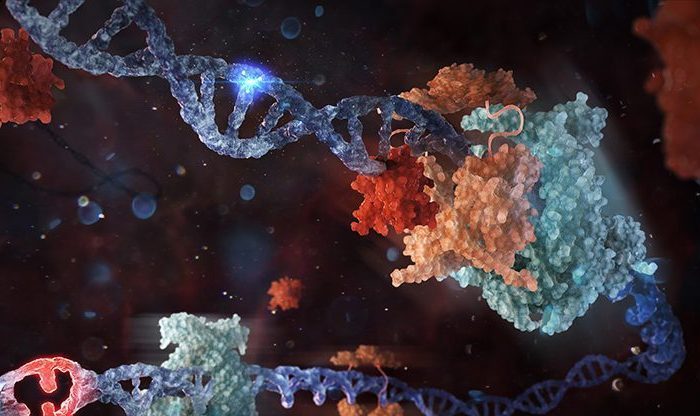
Our research centers on the mechanisms of eukaryotic DNA replication, using cryo-electron microscopy (cryo-EM) to visualize the dynamic structural transitions of key replication machinery. His work integrates structural biology and biochemistry to elucidate how multi-subunit protein complexes coordinate DNA melting, unwinding, and synthesis.
A major focus of his recent studies involves SV40 Large T antigen (LTag), a model helicase that provides mechanistic insight into the initiation and translocation phases of replication. By determining high-resolution cryo-EM structures of LTag in complex with double-stranded DNA (dsDNA), single-stranded DNA (ssDNA), and several intermediate conformations, his research reveals how LTag transitions from DNA melting to active translocation — offering a detailed view of how helicases remodel DNA during replication initiation.
Beyond LTag, Dr. Yuan’s lab aims to dissect replication and repair protein assemblies, exploring how ATP-driven conformational changes enable complex molecular functions. His broader vision is to visualize the molecular logic of DNA transactions, bridging structural snapshots with biochemical function.
Research Themes
- DNA replication mechanisms: architecture and function of eukaryotic replication complexes
- Helicase translocation and DNA melting: conformational intermediates and coordination mechanisms
- Cryo-EM structure determination: high-resolution mapping of dynamic protein–DNA complexes
- Structure-based mechanism discovery: linking structure to catalytic and biological function
Long-term Goal
To reveal, at molecular resolution, how life’s essential DNA processes are orchestrated, providing structural foundations for understanding genome stability and replication-associated diseases.